Understanding Industrial Facility Design and Piping Layout
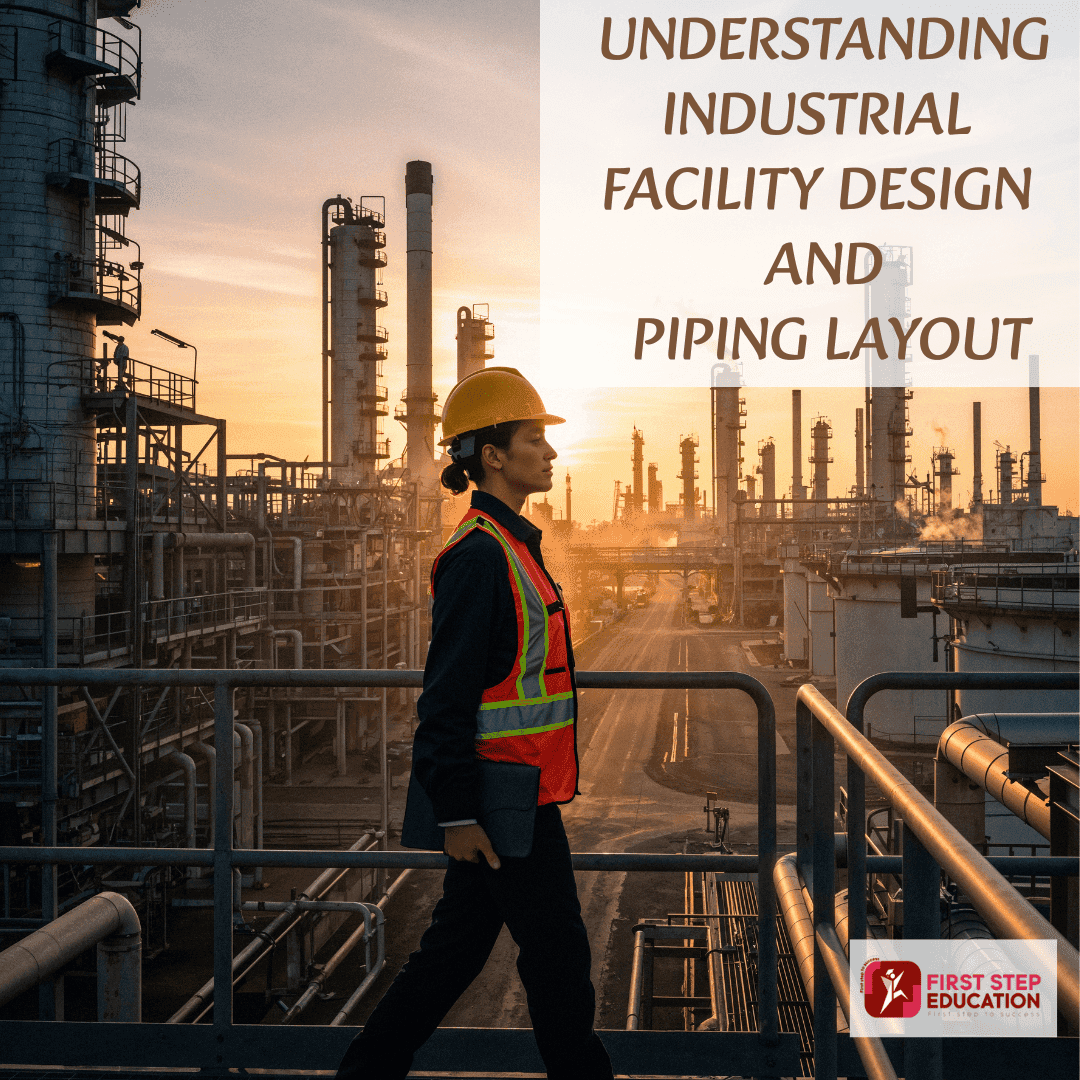
Designing an industrial facility is a collaborative and detail-oriented process. Engineers begin by developing process flow diagrams, defining project specifications, and selecting appropriate equipment. Using this information, design drafters apply their technical knowledge and field experience to create efficient facility layouts.
A key aspect of this process is piping design, which requires the creation of thousands of detailed drawings. These drawings guide construction teams and ensure that the facility meets safety regulations, government standards, client requirements, budget constraints, and project timelines.
The piping team plays a central role, coordinating closely with civil, structural, electrical, and instrumentation departments. They ensure all disciplines receive the necessary data to complete their tasks and deliver a fully integrated set of construction drawings on schedule. Designers may also visit construction sites to verify details and ensure accurate implementation of the design.
Industrial facility design and piping layout go far beyond simply arranging equipment and connecting pipes—they represent a strategic effort to translate a process idea into a functional, safe, and efficient physical system. Designing an industrial facility is a collaborative and detail-oriented process. Engineers begin by developing process flow diagrams, defining project specifications, and selecting appropriate equipment. Using this information, design drafters apply their technical knowledge and field experience to create efficient facility layouts.
At the core of industrial facility design is the understanding of process requirements. Engineers begin by analyzing how materials and energy flow through the system, often represented through diagrams like process flow diagrams (PFDs) and piping and instrumentation diagrams (P&IDs). These serve as blueprints for determining the size, type, and sequence of equipment such as reactors, pumps, heat exchangers, and storage units. The layout must ensure that each component is positioned to support smooth operations, minimize material handling effort, and reduce downtime during maintenance.
Another key consideration is spatial planning. Facilities are typically divided into functional zones—process areas, utility sections, storage zones, and administrative spaces. Proper spacing between equipment is essential not only for operational access but also for safety, especially in handling hazardous substances. Designers must also consider future expansion, leaving room for additional units without disrupting current operations.
Piping layout plays a vital role in connecting all these elements into a cohesive system. It involves determining the most efficient routing of pipes while accounting for physical constraints such as structural supports, elevation changes, and equipment orientation. Good piping design avoids congestion, reduces the number of fittings and directional changes, and ensures that pipelines are easy to inspect and maintain.
Thermal and mechanical behavior of piping systems is another crucial aspect. Pipes carrying high-temperature fluids expand and contract, which can lead to stress and potential failure if not properly managed. Designers incorporate flexibility through expansion loops, bends, or joints to absorb these movements. Similarly, proper support systems are designed to carry the weight of pipes, fluids, and insulation while preventing excessive vibration.
Safety is deeply embedded in both facility and piping design. This includes maintaining safe distances between hazardous and non-hazardous areas, providing clear access for emergency response, and ensuring that piping systems are routed away from critical escape paths. Materials selection is also guided by safety, considering corrosion resistance, pressure ratings, and compatibility with transported substances.
In addition, modern facility design integrates environmental and economic considerations. Efficient layouts can reduce energy consumption by shortening piping routes and optimizing heat recovery. Designers also aim to minimize waste generation and ensure compliance with environmental regulations.
Ultimately, industrial facility design and piping layout require a balance between technical precision and practical usability. The goal is to create a system where all components work together seamlessly—supporting continuous production, simplifying maintenance, enhancing safety, and adapting to future needs.
Software Tools
In parallel with engineering practices, the use of CAD and specialized piping software is fundamental to modern design workflows. Engineering firms must be flexible in adopting different software platforms based on client preferences. Widely used CAD tools such as AutoCAD and MicroStation are essential skills for designers.
Specialized piping software further enhances design capabilities by enabling intelligent modeling and visualization. Tools like AutoCAD Plant3D, SP3D, E3D, and CADWORX allow designers to create both 2D drawings and fully integrated 3D models of industrial facilities. These advanced systems improve accuracy, coordination, and efficiency, making them indispensable in today’s engineering design environment.
AutoCAD Plant3D - AutoCAD training is a structural educational program designed to teach users how to operate CAD software. It moves a student from basic computer drawing to creating complex, mathematically precise blueprints and 3D models used in real-world construction and manufacturing. AutoCAD Plant3D typically covers the end-to-end workflow for designing process plants, from initial P&ID schematics to final isometric and orthographic documentation
SP3D, E3D- Training for SP3D and E3D moves beyond basic CAD into high end data centric enterprise engineering software. These tools are the industry standards for massive-scale projects like oil rigs, refineries, and power plants.
CADWORX - This focuses on an AutoCAD based plant design suite that is popular for its balance of power and ease of use. Because it runs directly on top of AutoCAD (or BricsCAD), it has a much shorter learning curve than E3D or SP3D